
A day measured in prayer windows.
Wateera schedules what you do against Fajr, Shuruq, Dhuhr, Asr, Maghrib and Isha — not against 8 p.m. “Read twenty minutes after Maghrib” stays right in June, in December, and on the 27th of Ramadan.
iPhoneComing to the App Store
Not published yet. Written in Arabic and English, and there is no account to make.
Riyadh, today
This is the timeline.
Six windows, and they are not equal. Fajr to sunrise is about an hour; Isha runs until first light. Wateera draws the day at its real proportions and puts a marker on the minute you are in.
Calculated in this page for Riyadh (24.71° N, 46.68° E) by the Umm al-Qura method — the same method the app uses on your phone, and the same arithmetic. A calculated time is an approximation, not a religious ruling.
One place. Six lights.
Every sky on this page is the same Najdi horizon at a different hour. That is the app in one sentence: the place does not change, the light does.
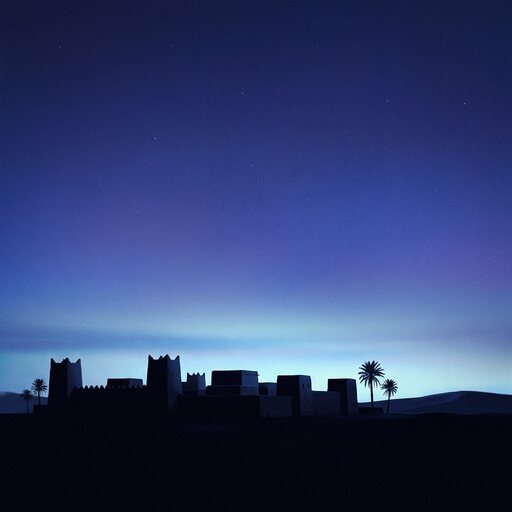 FajrFirst light to sunrise
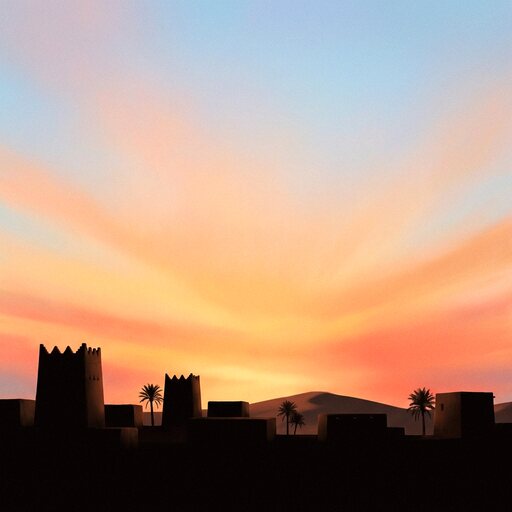 ShuruqSunrise to midday
 DhuhrMidday to mid-afternoon
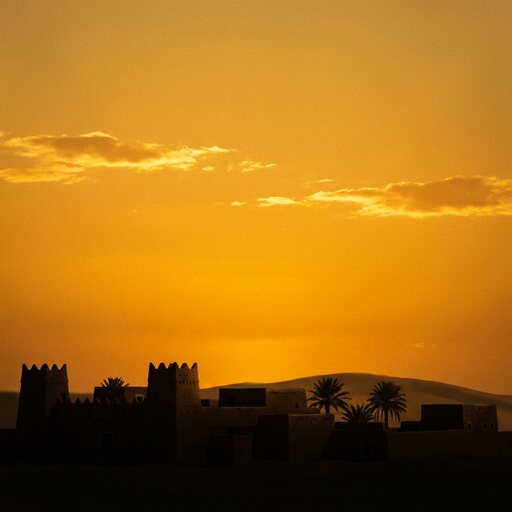 AsrMid-afternoon to sunset
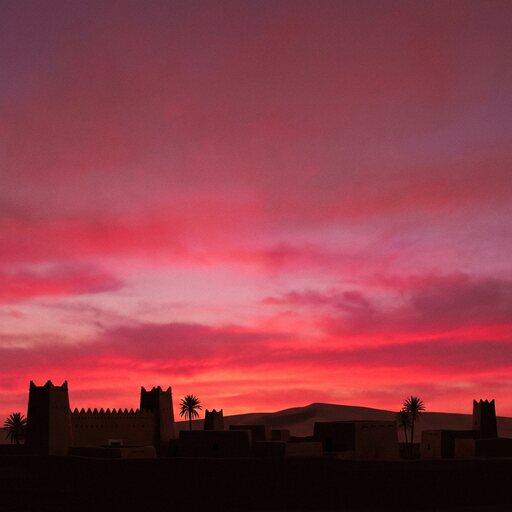 MaghribSunset to nightfall
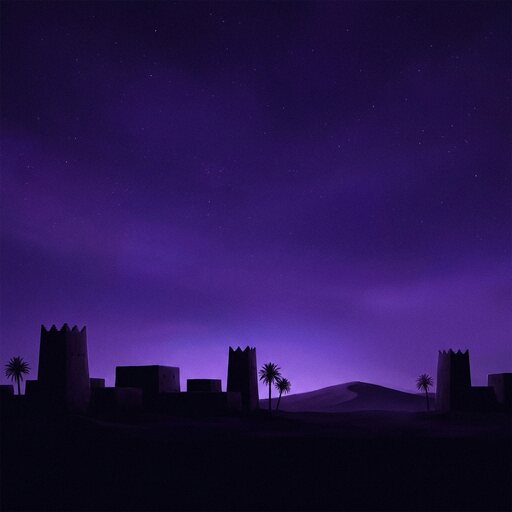 IshaNightfall to first light



The whole idea
8 p.m. is not a time of day. It is a number.
The sun keeps no office hours. A habit pinned to the clock drifts against the day all year; a habit pinned to a window does not move at all.
Read at 8:00 p.m.
Fixed to the clock. In Riyadh that lands 1 hr 15 min after Maghrib on 21 June and 2 hr 51 min after it on 21 December. One instruction, two completely different evenings.
Read 20 minutes after Maghrib
Fixed to the day. Twenty minutes after Maghrib is twenty minutes after Maghrib — in June, in December, and on the 27th of Ramadan. The clock time follows the sky, and you never touch it again.
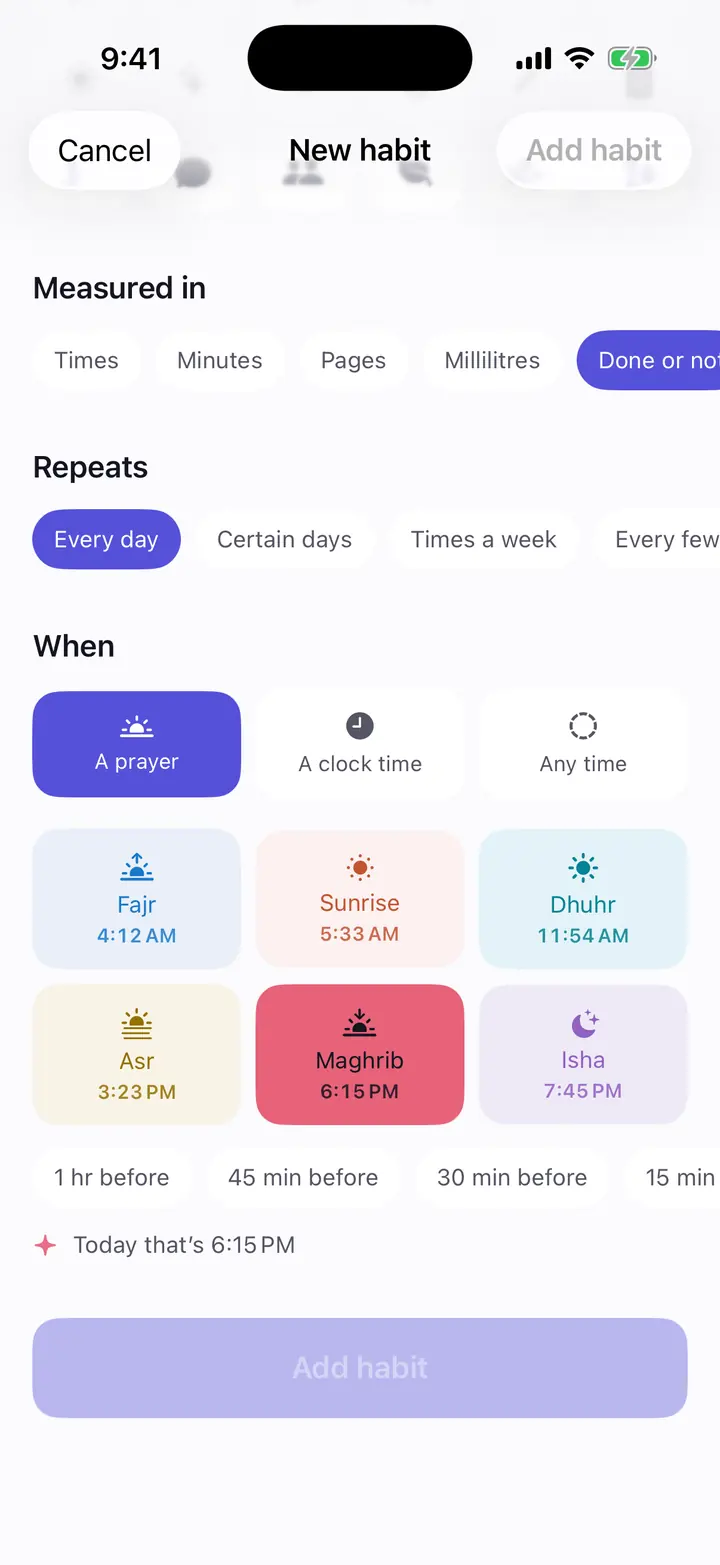
You pick the prayer, then the offset.
Before or after, in minutes, and the app tells you what that comes to today. The clock is still there if you want it: a habit can be set to a fixed time, or to no time at all.
- Pick a prayerFajr, sunrise, Dhuhr, Asr, Maghrib or Isha.
- Pick a side, and how farForty-five minutes before it, twenty minutes after it, or right on it.
- That is the whole settingThe app shows what it comes to today, and works it out again tomorrow.
Inside
What a day looks like.


The engine
Calculated on your iPhone. Never fetched.
Every day of a full year in Riyadh and in Jeddah. That is a statement about arithmetic, not about religious obligation.
Muslim World League, the Egyptian General Authority and Karachi are all there too — and the madhhab you take Asr at, one shadow length or two.
Minutes on or off each of the six times, individually. Set Maghrib to +2 once and your masjid and your app agree from then on — reminders included.
The sun's position for your coordinate and your date, computed on the device. It works on a plane, and it works on the day a server would have been down.
Every screen in the app that shows a time says calculated and names the method. For religious obligation, follow your mosque, your local authority or the calendar you trust.
What it will not do
There is no account, and there is no server.
Nothing to register, nothing to secure, and no credentials of yours for anyone to lose.
No analytics SDK, no attribution, no crash reporter, no remote configuration. The app makes no network request at all.
Your habits and your history stay in the app's own container on your iPhone. Export all of it, free, whenever you like.
Your location is read once, on the device, at about kilometre accuracy — a prayer time does not change across a neighbourhood — and used as the input to a calculation that runs on your iPhone. It is never transmitted. You can also refuse it and pick your city from a built-in list instead; nothing is withheld from someone who says no.
And Wateera never logs a prayer. It does not count them, score them, grade them or remind you about them. The windows are the clock your own habits hang on, never a scoreboard — a permanent boundary, not a feature that has not shipped yet.
App Store privacy label: Data Not Collected